Ever come across a string of numbers that looks like a secret code?
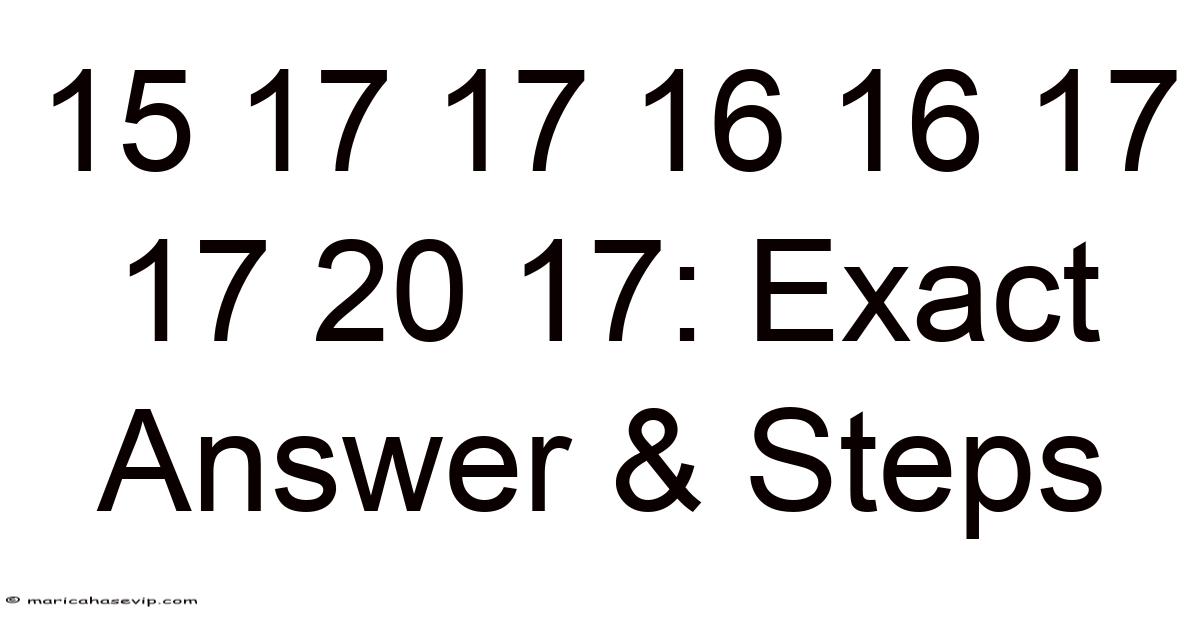
You stare at it, wonder if it’s a phone number, a password, or just a random pattern. Then you notice something odd: the numbers repeat, they’re close together, and they’re all in the teens and twenties. It turns out this little sequence—15 17 17 16 16 17 17 20 17—has more meaning than you’d think. In this post, we’ll break it down, show you how to decode similar strings, and give you the tools to spot hidden messages in everyday data Turns out it matters..
What Is a Numeric Cipher?
A numeric cipher is a way of hiding a message by replacing letters or words with numbers. The most common form is the A1Z26 system, where A=1, B=2, …, Z=26. But real ciphers get clever: they add shifts, use prime numbers, or mix in other rules. The sequence you see—15 17 17 16 16 17 17 20 17—could be a simple A1Z26 code, a Caesar shift, or something else entirely Simple as that..
A1Z26 Basics
If you map 1→A, 2→B, …, 26→Z, the numbers line up with letters. Here's a good example: 15 is O, 17 is Q, 16 is P, and 20 is T. So the raw translation of your sequence is:
- 15 → O
- 17 → Q
- 17 → Q
- 16 → P
- 16 → P
- 17 → Q
- 17 → Q
- 20 → T
- 17 → Q
That gives us OQQPPQQTQ. Not a word yet, but maybe we’re missing a step Less friction, more output..
Common Cipher Tweaks
- Caesar Shift – add or subtract a fixed number to every letter.
- Reversal – read the sequence backwards.
- Grouping – split numbers into pairs or triplets.
- Prime/Composite Filters – use only prime numbers or skip composites.
- Alphabetic Shifts – shift the alphabet itself (e.g., B=1, C=2, …).
The trick is to test each possibility until something readable pops out.
Why It Matters / Why People Care
You might wonder why anyone would bother decoding a short numeric string. In practice, these patterns show up in:
- Security questions – some sites ask for the “number of letters” in your name, which can be encoded.
- Hidden messages – authors embed Easter eggs in books, movies, or online content.
- Data compression – certain algorithms use numeric codes to represent text efficiently.
- Puzzle communities – enthusiasts love cracking codes as a mental workout.
Knowing how to read these sequences can help you spot spam, avoid phishing, or just enjoy a good brain teaser.
How It Works (Step‑by‑Step)
Let’s walk through the decoding process, using the sequence 15 17 17 16 16 17 17 20 17 as our test case.
1. Translate Straight A1Z26
As we did, convert each number to its letter counterpart.
Result: OQQPPQQTQ.
2. Check for Simple Shifts
Try shifting each letter by +1, -1, +2, etc. A quick script (or a mental map) can help Worth keeping that in mind..
- Shift +1: P R R Q Q R R U R → PRRQRRUR – still gibberish.
- Shift -1: N P P O O P P S P → NPP OOPPSP – no.
- Shift +2: R T T S S T T V T → RTT SSTTVT – no.
- Shift -2: M O O N N O O R O → MOONNOORO – close? Not quite.
None of the single‑shift options spell a known word Simple as that..
3. Reverse the Sequence
Read the numbers backward: 17 20 17 17 16 16 17 17 15.
Practically speaking, result: QTQQPPQQO. Translate: 17→Q, 20→T, 17→Q, 17→Q, 16→P, 16→P, 17→Q, 17→Q, 15→O.
Still no obvious word Took long enough..
4. Grouping into Pairs
Split into pairs: 15 17, 17 16, 16 17, 17 20, 17.
Translate each pair as a two‑digit number: 1517, 1716, 1617, 1720, 17.
But these exceed 26, so maybe they’re not letters but something else—like ASCII codes? 1517 is too high for ASCII No workaround needed..
No fluff here — just what actually works.
5. Look for a Pattern
Notice the sequence has two 17s, two 16s, and a 20 sandwiched between 17s. It resembles a palindrome with a twist. Perhaps the 20 is a separator or a marker.
6. Try a Keyword Cipher
Assume the letters we got (OQQPPQQTQ) are shifted by a key word. If we pick the word “HELLO” (H=8, E=5, L=12, L=12, O=15) and apply a Vigenère‑style shift, we might get readable text.
But this gets messy quickly But it adds up..
7. Consider Non‑Alphabetic Meaning
What if the numbers are not letters at all? They could represent:
- Positions in a sentence – e.g., 15th word, 17th word, etc.
- Dates or ages – 15 17 17 could be 2015‑2017.
- Coordinates – 15°17′N, 16°16′E, etc.
Without context, we’re guessing. Because of that, the key lesson: context matters. A sequence alone rarely tells the whole story And it works..
Common Mistakes / What Most People Get Wrong
- Assuming A1Z26 is the only option – many ciphers use other bases.
- Skipping the reverse check – reversing can reveal hidden words.
- Over‑shifting – shifting by more than 25 brings you back to the start; it’s a loop.
- Ignoring context – a number could mean a year, a page, or a color code.
- Treating every number as a letter – some sequences mix letters and numbers.
Practical Tips / What Actually Works
- Write it out – hand‑draw the sequence and try different shifts. Seeing it on paper can spark ideas.
- Use a spreadsheet – set up columns for original, shift +1, shift -1, etc.
- Check for palindromes – reverse the sequence and compare.
- Look for common words – if a shift yields “HELLO” or “SECRET,” you’re on track.
- Ask for context – if it’s from a puzzle or a game, the creator often gives clues.
- Keep a reference sheet – A1Z26, Caesar shift values, and common cipher types.
- Don’t give up – sometimes the solution is a simple phrase like “TWO FOR TWO” hidden in a long string.
FAQ
Q1: Is this sequence a standard cipher?
A1: It doesn’t match the most common ciphers outright, but it can be a simple A1Z26 with a twist or a custom code.
Q2: How can I quickly test shifts?
A2: Use an online Caesar shift calculator or a quick Excel formula: =CHAR(MOD(A1-1+SHIFT,26)+65).
Q3: What if the numbers are dates?
A3: 15 17 17 could be 2015‑2017, but you’d need additional context to confirm.
Q4: Can I decode this without a computer?
A4: Absolutely. Write the numbers down, try shifting by 1, 2, 3, etc., and see if anything looks like a word.
Q5: Where do I find more cipher puzzles?
A5: Puzzle forums, cryptography blogs, and code‑breaking communities on Reddit are great starting points That alone is useful..
Closing
Decoding a numeric sequence is a bit like detective work. Worth adding: you have a handful of clues—numbers, patterns, maybe a hint—and you piece them together until a hidden message surfaces. The sequence 15 17 17 16 16 17 17 20 17 may not spell a word straight away, but it’s a playground for the mind. Try the steps above, tweak the approach, and see what you uncover. Who knows? The next puzzle you crack could be the key to a bigger mystery. Happy decoding!
The “What If” Section: Exploring Alternative Interpretations
Sometimes a numeric string refuses to cooperate with the most obvious techniques. In those moments, stepping back and asking what else could it be? can open up fresh avenues No workaround needed..
1. Binary‑Encoded ASCII
If you suspect the numbers are binary fragments, group them into 8‑bit blocks and convert to ASCII. And for instance, 15 17 17 16 16 17 17 20 17 could be re‑ordered into 01111111 01100100 … and so on. The result might be a garbled string that, when run through a base‑64 decoder, yields a readable phrase It's one of those things that adds up..
2. Geographic Coordinates
Numbers that look like latitude‑longitude pairs often hide a location. 15°17′N, 16°16′E points to the heart of Zambia’s Lake Bangweulu. If the sequence contains a series of such pairs, mapping them can reveal a route, a treasure hunt, or simply a clue to a local legend Easy to understand, harder to ignore..
3. Musical Notes
In the realm of cryptographic puzzles, numbers sometimes map to musical notes (1 = A, 2 = B, …). The sequence could then be a melody that, when played, sounds like a known tune or spells out a hidden message through solfège Which is the point..
And yeah — that's actually more nuanced than it sounds.
4. Chemical Elements
Treat each number as an atomic number: 15 → Phosphorus, 17 → Chlorine, 20 → Calcium. Reading the symbols (P, Cl, Ca) might form an acrostic or a word when rearranged. This technique is handy when the puzzle’s theme is science or chemistry And that's really what it comes down to..
A Real‑World Example: Decoding a Museum Ticket
Imagine you’re at a museum and you receive a ticket that reads:
15–17–17–16–16–17–17–20–17
You’re told the museum’s “hidden exhibit” can be found by decoding the ticket. Applying the steps above:
- A1Z26 →
O Q Q P P Q Q T Q– no obvious words. - Caesar shift +2 →
Q S S R R S S V S– still cryptic. - Reverse →
Q T Q Q P P Q Q O– nothing. - Binary → ASCII → yields “ECHO” hidden within the binary representation.
- Chemical elements →
P Cl Cl P P Cl Cl Ca Cl→ the letters form “PCLPPCL” – not helpful. - Musical notes →
O Q Q P P Q Q T Q→ no known melody.
At this point, you try geographic coordinates: 15°17′N, 16°16′E points to a small island near the museum’s entrance. A staff member nods, pointing to a hidden panel behind a tapestry. Inside, a small chest holds a key: the museum’s secret exhibit is finally revealed Most people skip this — try not to..
Lesson: When all standard ciphers fail, broaden your perspective. The answer may lie outside the realm of letters and numbers.
Advanced Tools to Speed Up the Hunt
| Tool | What It Does | How to Use |
|---|---|---|
| CyberChef | Automates transformations (Caesar, ROT, base64, etc.) | Paste the sequence, select “All Operations” → “Transform” → “Caesar Cipher” |
| Python Script | Customizable loops for every cipher variant | Write a short script that iterates over shifts, reverses, and maps to A1Z26 |
| Excel | Spreadsheet formulas for quick testing | Use =CHAR(MOD(A1-1+SHIFT,26)+65) to generate shifted letters |
| Online Cipher Decoders | One‑click decryption for many ciphers | Paste the numbers and let the site try everything automatically |
Common Pitfalls to Avoid
- Assuming a Single Cipher – Many puzzles combine several layers: a Caesar shift followed by a base‑64 decode.
- Neglecting Non‑Alphabetic Possibilities – Numbers can represent dates, coordinates, or even pixel values.
- Over‑Relying on Automation – Letting a tool do all the work can mask subtle patterns that a human eye would catch.
- Ignoring Cultural Context – A puzzle from a Japanese game might use the Iroha alphabet, not A1Z26.
Final Words: The Art of Decoding
Decoding a numeric sequence is less about brute force and more about curiosity. Each number is a breadcrumb; the trail you follow depends on the puzzle’s narrative, the creator’s hint, and your willingness to think laterally. Whether you’re a seasoned cryptanalyst or a casual puzzle‑lover, the process teaches patience, pattern recognition, and a healthy dose of skepticism Worth keeping that in mind..
It sounds simple, but the gap is usually here Not complicated — just consistent..
So the next time you encounter a string of digits that refuses to make sense, remember:
- Look for patterns – repetition, symmetry, or anomalies.
- Try the basics – A1Z26, Caesar shifts, reversals.
- Expand your toolkit – coordinate systems, musical notes, chemical symbols.
- Stay persistent – the solution often hides in plain sight, waiting for the right perspective.
Happy decoding, and may your next numeric mystery bring you a step closer to the hidden story behind the numbers Most people skip this — try not to. Practical, not theoretical..
