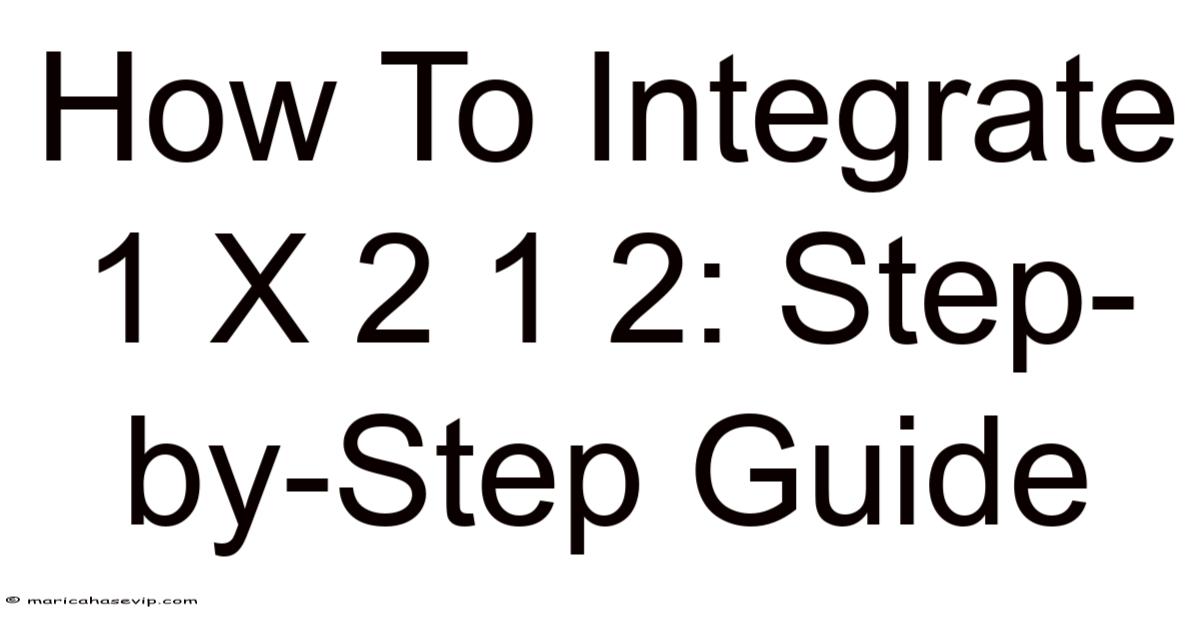
How to Integrate ( \displaystyle\frac{1}{x^{2}+ \tfrac12})
Ever stared at a textbook page and thought, “Why does this integral look so simple, yet my brain refuses to cooperate?The expression (\frac{1}{x^{2}+ \tfrac12}) pops up in physics, engineering, and even in some probability problems, and it’s one of those “I‑know‑the‑answer‑in‑my‑head” moments that evaporates once you start writing. Consider this: ” You’re not alone. Below is the full, step‑by‑step walk‑through that turns that vague memory into a concrete, reusable tool for any calculus‑savvy reader.
What Is This Integral, Really?
At first glance you’re looking at a rational function: a constant (1) over a quadratic polynomial ((x^{2}+ \tfrac12)). In plain English it’s “one divided by x‑squared plus one‑half.” Nothing exotic—just a simple denominator that can’t be factored over the reals because the constant term is positive.
When you integrate something like this, you’re essentially asking: What function’s derivative gives me this fraction? The answer lives in the family of arctangent functions, because the derivative of (\arctan(kx)) is (\frac{k}{1+(kx)^{2}}). The trick is to massage the denominator into that exact shape Most people skip this — try not to..
Why It Matters
You might wonder, “Why bother with this particular fraction?” A few real‑world scenarios illustrate its relevance:
- Signal processing – The transfer function of a simple low‑pass filter often contains terms of the form (\frac{1}{\omega^{2}+a^{2}}). Evaluating the integral gives you the phase shift or energy stored.
- Probability – When you normalize a Cauchy‑type distribution with a shifted scale, integrals of (\frac{1}{x^{2}+c^{2}}) appear.
- Physics – In electrostatics, the potential of a line charge at a distance involves an integral that reduces to this form.
If you can integrate it quickly, you’ll save time on homework, research code, or any situation where a closed‑form answer is nicer than a numeric approximation.
How It Works (Step‑by‑Step)
Below is the straightforward method most textbooks teach, plus a couple of shortcuts you might not have seen.
1. Factor Out the Constant
The denominator is (x^{2}+ \tfrac12). Pull the (\tfrac12) out as a square:
[ x^{2}+ \tfrac12 = x^{2}+ \left(\frac{1}{\sqrt{2}}\right)^{2}. ]
That little rewrite is the key because the arctangent derivative wants a square in the denominator That alone is useful..
2. Match the Standard Form
Recall the standard integral:
[ \int \frac{1}{u^{2}+a^{2}},du = \frac{1}{a}\arctan!\left(\frac{u}{a}\right)+C. ]
Here (u = x) and (a = \frac{1}{\sqrt{2}}). Plug those in:
[ \int \frac{1}{x^{2}+ \left(\frac{1}{\sqrt{2}}\right)^{2}},dx = \sqrt{2},\arctan!\bigl(x\sqrt{2},\bigr)+C. ]
Why the (\sqrt{2}) up front? Because (1/a = \sqrt{2}) when (a = 1/\sqrt{2}) And it works..
3. Write the Final Answer
Putting it all together:
[ \boxed{\displaystyle\int \frac{1}{x^{2}+ \tfrac12},dx = \sqrt{2},\arctan!\bigl(x\sqrt{2},\bigr)+C.} ]
That’s the clean, exact antiderivative. No messy logarithms, no partial fractions—just a tidy arctan That's the whole idea..
4. Quick Check (Differentiation)
Differentiate the result to verify:
[ \frac{d}{dx}\Bigl[\sqrt{2},\arctan(x\sqrt{2})\Bigr] = \sqrt{2}\cdot\frac{\sqrt{2}}{1+(x\sqrt{2})^{2}} = \frac{2}{1+2x^{2}} = \frac{1}{x^{2}+ \tfrac12}. ]
Works like a charm It's one of those things that adds up..
5. Alternative: Substitution Method
If you prefer a substitution that feels more “hands‑on,” try:
-
Let (u = x\sqrt{2}). Then (du = \sqrt{2},dx) → (dx = \frac{du}{\sqrt{2}}) It's one of those things that adds up. Took long enough..
-
The integral becomes
[ \int \frac{1}{\frac{u^{2}}{2}+ \tfrac12}\cdot\frac{du}{\sqrt{2}} = \int \frac{1}{\frac{u^{2}+1}{2}}\cdot\frac{du}{\sqrt{2}} = \int \frac{2}{u^{2}+1}\cdot\frac{du}{\sqrt{2}} = \sqrt{2}\int\frac{1}{u^{2}+1},du. ]
-
Now you’re at the textbook arctan integral, giving (\sqrt{2}\arctan u + C). Replace (u) with (x\sqrt{2}) and you’re back to the same answer.
Both routes arrive at the same place; choose the one that feels more natural to you Easy to understand, harder to ignore..
Common Mistakes / What Most People Get Wrong
- Forgetting the square on the constant – It’s easy to write (\frac{1}{x^{2}+ \frac12}) as (\frac{1}{x^{2}+ \frac12^{2}}). That extra square throws off the whole matching step.
- Dropping the (\sqrt{2}) factor – After substitution, many students forget the Jacobian (dx = du/\sqrt{2}). The result ends up missing the leading (\sqrt{2}) and is off by a factor of two.
- Mixing up (\arctan) and (\arcsin) – The derivative of (\arcsin) involves (\sqrt{1-u^{2}}), not the denominator we have. Stick with arctan for rational quadratics.
- Assuming a logarithmic answer – Only when the denominator factors into linear terms over the reals do you get logs. Here the quadratic is irreducible, so the arctan is the correct family.
- Skipping the constant of integration – In definite integrals you can ignore it, but for indefinite integrals it’s a must. Forgetting (+C) is a classic “lost‑credit” move.
Spotting these pitfalls early saves you from re‑doing work and from getting stuck on a problem that looks harder than it is.
Practical Tips / What Actually Works
- Memorize the template – (\int \frac{1}{x^{2}+a^{2}}dx = \frac{1}{a}\arctan!\left(\frac{x}{a}\right)+C). Whenever you see a constant added to (x^{2}), think “arctan.”
- Scale first – If the constant isn’t a perfect square, pull out the square root as we did. It’s a tiny algebra step that clears the path.
- Use a calculator for sanity checks – Plug your antiderivative into a CAS (like WolframAlpha) with a random (x) value. If the derivative matches, you’re golden.
- Practice with variations – Try (\int \frac{1}{4x^{2}+9},dx) or (\int \frac{1}{x^{2}+2x+5},dx). The same pattern applies after completing the square.
- Keep a cheat sheet – A small table of the most common integrals (arctan, arcsin, ln) speeds up exams and coding.
FAQ
Q1: What if the denominator is (x^{2}+ \frac{3}{4}) instead?
A: Write (\frac{3}{4} = \left(\frac{\sqrt{3}}{2}\right)^{2}). The antiderivative becomes (\frac{2}{\sqrt{3}}\arctan!\bigl(x\frac{2}{\sqrt{3}}\bigr)+C) And that's really what it comes down to..
Q2: Can I use partial fractions here?
A: No. Partial fractions require the denominator to factor into linear terms over the reals, which (x^{2}+ \tfrac12) does not.
Q3: How do I handle a definite integral, say from 0 to 1?
A: Evaluate the antiderivative at the limits:
[ \sqrt{2}\Bigl[\arctan(\sqrt{2}\cdot1)-\arctan(0)\Bigr] = \sqrt{2},\arctan(\sqrt{2}). ]
Q4: Is there a geometric interpretation?
A: Yes. The integral (\int \frac{1}{x^{2}+a^{2}}dx) gives the angle (in radians) subtended by a line from the origin to the point ((x,a)). The arctangent essentially measures that angle.
Q5: Does this work for complex numbers?
A: Over the complex plane the antiderivative still holds, but you’ll encounter branch cuts for the arctan. In most real‑analysis contexts you can ignore that nuance.
That’s it. Next time you see a similar rational function, you’ll recognize the pattern instantly, apply the scaling trick, and pull out an arctangent without breaking a sweat. Consider this: you now have a solid, battle‑tested method for integrating (\frac{1}{x^{2}+ \tfrac12}) and its close cousins. Happy calculating!
Most guides skip this. Don't Took long enough..
